A Service Dog for Cat


Click here to email us!


The Dog
We're very lucky to be working with the head trainer from Northwest Battle Buddies and Man's Best Friend in Battle Ground, WA to train Cat's puppy.
We will be buying a dog from the same breeder and lineage they use for the Battle Buddies service dogs, either an English Lab or an English Retriever.
Once the dog is old enough, it will go through the residential training program at Man's Best Friend, and then we will begin one on one training for the Canine Good Citizen Test. We will also train specifically for the mobility and psychiatric tasks the dog will use to help Cat. This process will take 2 to 3 years.
Costs we need your help with
-
Puppy $2,000 to 3,000
-
Initial Training $2500
-
Ongoing Training $150/hour
What is POTS?
1 in 100 teens has POTS!
Postural Orthostatic Tachycardia Syndrome (POTS) is a form of dysautonomia, which is a disorder of the autonomic nervous system. The autonomic nervous system controls things like breathing, blood pressure, digestion, heart rate, sweating, and a number of other non-voluntary bodily functions.
In a healthy body, when you stand the blood vessels in your legs constrict, sending blood up towards your heart and brain.
In people with POTS, those vessels don't constrict correctly, leaving the blood pooling in the arms and lower part of the body. This leaves the heart without enough blood to pump, so it beats faster, trying to raise the blood pressure and get more blood, but there isn't any, so the blood pressure falls, leaving the person lightheaded and faint.
See More Below For Cat's Experience
Fundraisers
Cat's Journey


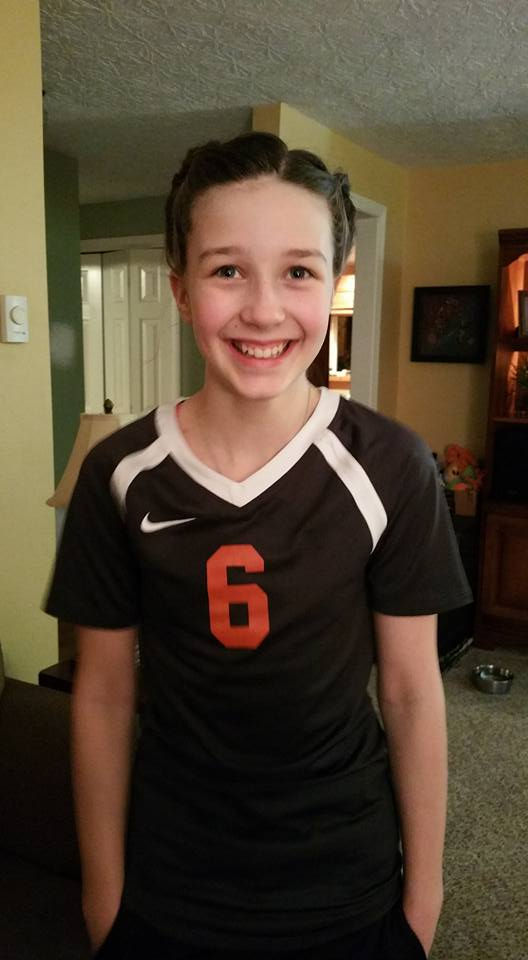
When Cat was 9 years old, she began playing volleyball through the local community education organization...and she was good. Her mother, Sarah, was thrilled that Cat was tall and lanky, and could play the positions that Sarah never good.
Spurred on by Cat's talent, they signed her up for competitive volleyball, two hour practices 2-3x a week, and travel tournaments at least once a month. Cat excelled as a setter, and worked hard at home and during practice. Once the season ended, she signed up for pairs beach volleyball with a close friend. The time between the end of the first season, and beginning of beach ball was about 6 weeks.
Beach volleyball practice started, and almost immediately it was clear there was something wrong. Cat suddenly couldn't complete warm-ups without becoming pale, shaky, and clammy. Once wasn't much to worry about, but this continued with every practice.
Initially, low blood sugar was suspect, but after a few weeks of glucose monitoring, it was clear that wasn't the problem. Sarah had learned about POTS years ago on a YouTube rabbit hole spiral, and started wondering if that could be what Cat had. The doctor said no, only old people could have dysautonomia, though the doctor did diagnose her with orthostatic hypotension with tachycardia (low blood pressure from laying to standing, and fast heartbeat). They did an EKG, an echocardiogram, said eat more salt, drink more water, and sent her away.
Cat was barely able to walk. She would crawl to her bedroom, or to go to the bathroom. Walking outside in the summer heat was impossible and she would fall to her knees, unable to move. Towards the end of summer she improved a bit, able to participate minimally in a volleyball summer camp. Encouraged, they signed her up for another season of travel volleyball.
She struggled. Cat pushed through practices, working hard to not let anyone see her pain. As soon as she got in the car, should would fall apart, sobbing and shaking, with a splitting headache and absolutely no strength left in her. School was nearly impossible. After a disagreement with the coach about an unrelated matter, Sarah pulled Cat from the team. Neither Sarah or Cat were disappointed.
School improved a bit, without the stress of volleyball, but not much. Back to the doctor. Test after test. The entire time, Sarah would suggest POTS. "Nope, couldn't be," she was told. Cat was told, "All your friends have this too, huh? You like potato chips? Those are salty, eat more potato chips." Yes, this was a quote from a well-respected child cardiologist.
With doctors no help, Sarah turned to support groups to treat what she knew Cat had, POTS. She learned all about compression clothing, salt pills (not potato chips), 3-5 liters of water a day, and a list of other tests to request from the doctors. Cat was tested for nearly everything under the sun. No abnormalities. One neurologist even said she did probably have POTS! But he refused to diagnose it, as it wasn't something he wanted to treat. And not one doctor would order the tilt table test that Sarah requested, the nearly definitive test for POTS.
Years went by. Cat struggled. See, POTS doesn't just affect your blood pressure and heart rate. It's headaches, weakness, trouble sleeping, stomach pain, and for Cat, serious "brain fog" that left her unable to follow even a simple television show. Time with friends was minimal, school was a struggle. She missed 2-4 days a week and when there was in too much pain to really engage. Sarah heard of a new doctor, a naturopath at OHSU who specialized in POTS. After a few months wait, they got in and the doctor ordered the coveted Tilt Table Test! And it came back POSITIVE FOR POSTURAL ORTHOSTATIC TACHYCARDIA SYNDROME!
It may not seem like something to celebrate, but when you fight for years to be taken seriously, having your condition confirmed is a huge blessing! How long had it been since Sarah asked the doctors about POTS? Four years.
By this time, Cat was a freshman in high school. And doing worse than ever. She dropped from full time in-person school to 3 classes in school, and 3 classes online. But it was too much, so she dropped the online classes. Despite the cutback, she was only making it to school 2 or 3 days a week. She was unable to do homework. That April, Sarah pulled her from school. What's the point in pushing Cat if it's making her worse, and she's not able to learn?
Around this time, they found a great pediatric neurologist who truly listened to what Cat needed. They found an allergist who said Cat had mast cell issues, and began treating her.
They struggled through the summer. Sophomore year was coming up, but Cat was even worse than before. Sarah made the difficult step to keep Cat out of school for the entire year, not even online schooling. And, without that physical and mental stress, Cat slowly (very slowly) progressed!
Cat got a wheelchair...and it opened up the world to her, just a little. She was able to go to the grocery store again, though only for short times, but it was out of the house!! She was able to start reading again, watching new television shows, having full conversations, and spend some time with friends.
As her junior year rolled around, they decided she was ready to try online schooling. And that's where she is now. Cat is in her Junior year at Insight School of Washington. It's been rough, and she's definitely in a downward trend right now, but there is hope that if she was able to overcome it before, she will again.